
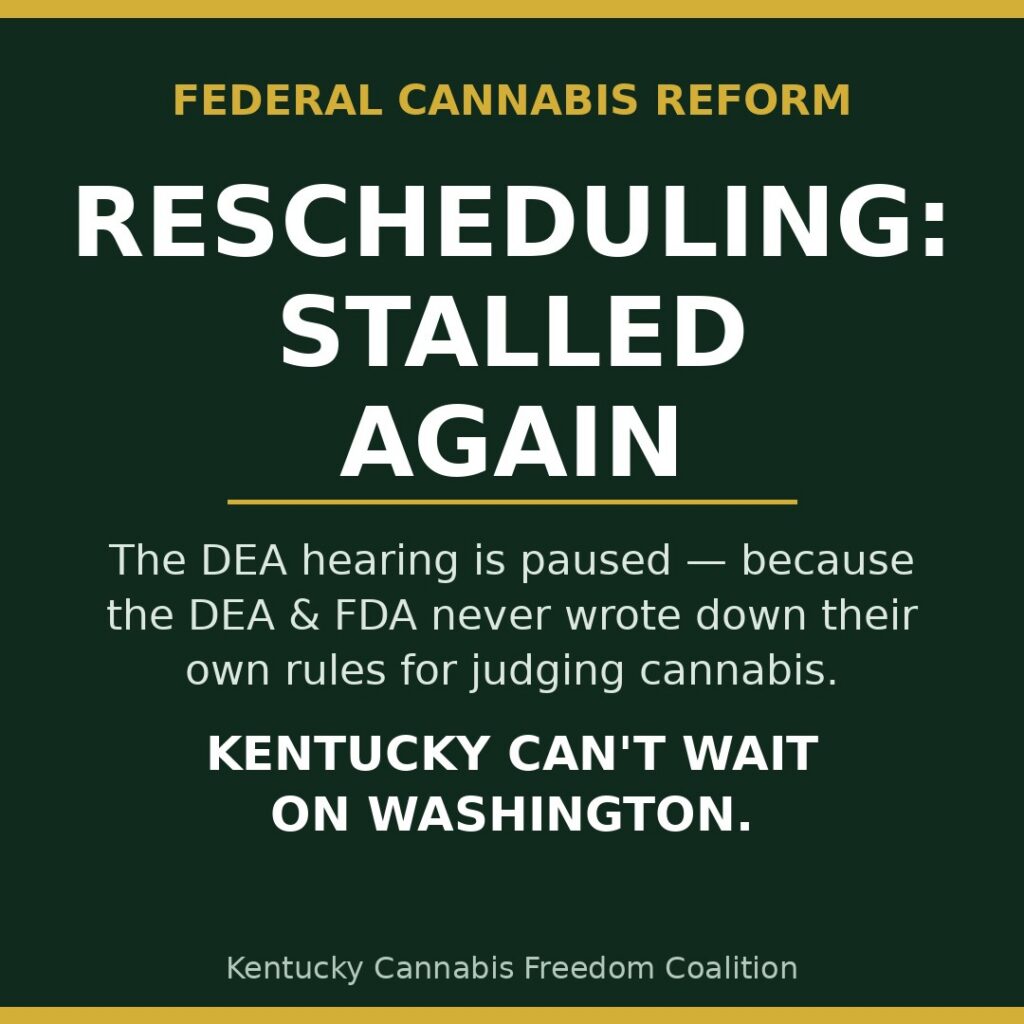
Washington has hit pause on cannabis reform — again.
DEA Chief Administrative Law Judge Derek C. Julius has halted the federal hearing on moving cannabis from Schedule I to Schedule III. The reason? He needs to decide whether a new Government Accountability Office (GAO) report should be admitted as evidence in the case.
That report is damning in the driest possible way: it found that neither the DEA nor the FDA ever wrote down formal procedures for how they evaluate and schedule controlled substances. The agencies making life-and-death decisions about cannabis have no written playbook. The GAO recommended both agencies establish clear policies to fix the gap — and now the hearing itself is stuck while everyone argues about the paperwork.
How we got here
In August 2023, the Department of Health and Human Services recommended moving cannabis to Schedule III, following a scientific review requested by President Biden. That kicked off the DEA’s formal rulemaking process, including this administrative hearing. Testimony has come in from state regulators, medical researchers, and industry stakeholders on both sides.
Note: a separate federal order earlier this year already moved FDA-approved cannabis products and cannabis within qualifying state-licensed medical programs — including Kentucky’s — to Schedule III. But the broader rescheduling of cannabis itself remains unfinished, and this hearing is where it lives or dies.
What Schedule III would — and wouldn’t — do
Schedule III would be real progress: state-licensed cannabis businesses could finally claim standard tax deductions (today, Section 280E blocks them, pushing effective tax rates above 70%), and research restrictions would ease.
But let’s be clear about what it is not. Schedule III is not legalization. Federal prohibition stays. And it would not change Kentucky law by one word — Kentuckians would still be arrested for simple possession. Kentucky made 2,718 cannabis arrests in 2025 alone, and 80% were for possession.
No timeline — and Kentucky can’t wait for one
Judge Julius has given no indication of how long the pause will last. Even after the hearing wraps up, the judge only makes a recommendation — the final decision rests with the DEA administrator, and any final rule will likely face legal challenges. Reporting suggests a decision could slip well into 2027.
Kentucky doesn’t have to wait on Washington. Our path runs through Frankfort: a constitutional amendment putting decriminalization on the ballot, so Kentuckians — not federal agencies — decide. Adults 21+ would be able to possess up to one ounce and cultivate, harvest, and store up to five plants for personal use.
Take action
✍️ Sign the petition — 10,400+ verified signatures and counting: https://change.org/LetKentuckyVote
📞 Call the Kentucky legislative message hotline at 1-800-372-7181 and tell your state senator and representative: put cannabis decriminalization on the ballot.
Washington can take its time. Kentucky shouldn’t have to.
Sources: Ganjapreneur reporting on the DEA administrative hearing and Judge Derek C. Julius’s pause; U.S. Government Accountability Office report on DEA/FDA scheduling procedures; Marijuana Policy Project / FBI Crime Explorer arrest data (2025).
Leave a Reply